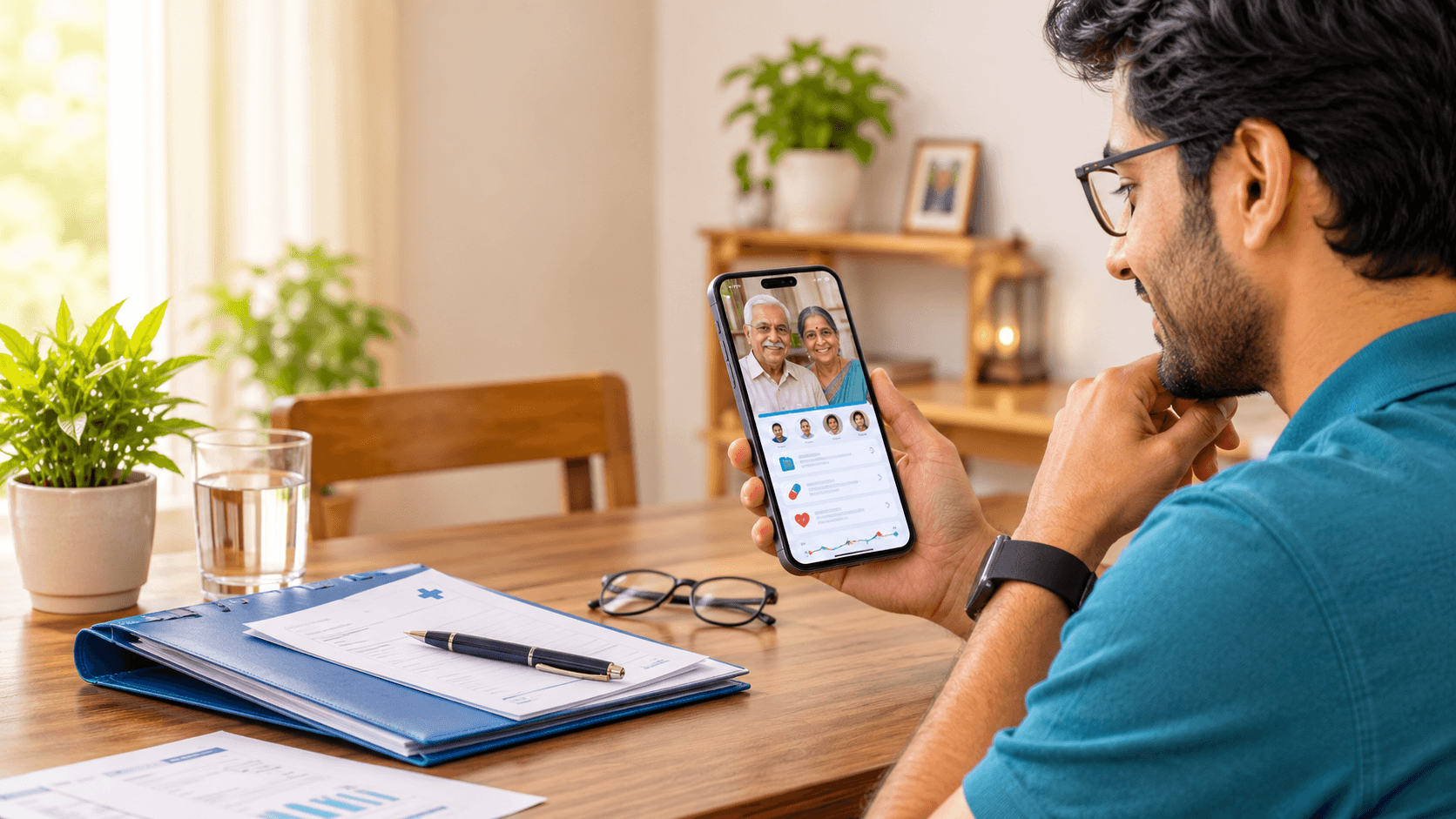
A family health records app keeps every family member's medicines, reports, allergies and doctor visits in one organised place, so you can find what you need in seconds. For caregivers managing parents' health from another city, the biggest benefits are less searching, fewer mix-ups and easier conversations with doctors.
MedicalPassbook is built around this idea. Each person gets their own secure Passbook, and you can look after your parents' family health records with their permission, from wherever you live.
Below are seven practical benefits, explained plainly, along with what the app does not do.
Key takeaways
Keep one Passbook for each family member so records never get mixed up.
Take one photo of a prescription and confirm the draft medicines instead of typing them.
Check your parents' medicines and recent readings from another city before you call them.
Share records with a doctor for a limited time, and stop sharing whenever you want.
Set up the emergency card with blood group, allergies, medicines and contacts.
What is a family health records app?
A family health records app is a secure place on your phone to store the health information of everyone in your family. It holds medicines, prescriptions, test reports, allergies, conditions and readings like blood pressure, sorted by person. It replaces the plastic folder, the WhatsApp chat full of photos and the notes in your head.
In many Indian homes, the 'medical file' lives in a cupboard at your parents' house. That works until you need it at 10 p.m., in another city, while speaking to a doctor on the phone.
A digital record does not replace your doctor or your paper file overnight. It simply means the important details are with you, and with the right people, when they are needed.
What makes a good one for Indian families
Look for an app that keeps each person separate, works in Hindi as well as English, and lets you share with a doctor without losing control. It should also be simple enough that your parents can open it themselves.

Benefit 1: Every family member's records, kept separately
When you look after two parents, maybe an in-law, and your own children, papers get mixed quickly. One father's sugar report ends up in another person's file. A cough syrup photo has no name on it.
With separate Passbooks for each family member, every record belongs to one person. Inside each Passbook, you can keep:
Medicines with their schedules, such as '1-0-1' or 'after food'
Allergies and ongoing conditions
Documents like prescriptions, discharge summaries and lab reports
Readings such as BP, sugar, weight and heart rate
A health timeline that shows what happened and when
Access is permission-based. Your parents' Passbooks are theirs, and you manage them because they have allowed it.
Benefit 2: One prescription photo instead of hours of typing
Most caregivers give up on digital records because entering everything feels like a second job. A good app should make one photo the only work you do.
With prescription photo reading, you take a picture of the doctor's prescription. MedicalPassbook reads it into draft medicines, with names and schedules. You then check each one and confirm it.
Why you still confirm every medicine
Handwriting can be hard to read, and abbreviations differ between doctors. That is why nothing is saved as a medicine until you confirm it. The app assists; you decide. If anything on the prescription is unclear, ask your doctor or pharmacist before you confirm it.
Benefit 3: How does it help if your parents live in another city?
When you live in another city, a family health records app lets you see your parents' current medicines, recent reports and readings without asking them to find papers. You can prepare before a phone call, notice when something has changed, and answer a doctor's questions with the right details in front of you.
Small, everyday moments become easier:
Your mother says the doctor 'changed one tablet'. You can check which one, and when.
Your father's BP readings are added to his Passbook, so you can see them before you call.
A sibling in a third city can help, with permission, instead of relying on forwarded photos.
Medicine reminders on the phone and WhatsApp, and alerts to caregivers when a dose is missed, are coming soon. You can read about one family's experience during a stroke to see why having records ready matters.
Before a doctor's appointment
Even when you cannot travel, you can help your parents prepare. Open their Passbook a day before and note what the doctor may ask about.
The current medicine list, with schedules
Recent BP or sugar readings, if they track them
Any new report since the last visit
Questions your parents want to ask, written down so they are not forgotten
Your parents walk in with the full picture, and you can join the call knowing the same facts they do.
Benefit 4: Sharing records with a doctor, on your terms
Sending photos to a doctor on WhatsApp is common, but once sent, those photos stay on someone else's phone. You also cannot tell what they have seen.
Time-limited sharing with a doctor works differently. The doctor gets read-only access for a set time. You always see who can view what, and until when, and you can stop sharing at any time.
Question | Photos on WhatsApp | MedicalPassbook sharing |
|---|---|---|
Can the doctor see the full history in order? | Only what you send | Yes, organised by date and type |
Does access end? | No | Yes, when the time limit ends or you stop it |
Can the doctor change anything? | Not applicable | No, it is read-only |
Can you see who has access? | Hard to track | Yes, always shown |
Benefit 5: Key details ready in an emergency
In an emergency, people around your parent may need basic facts quickly: blood group, allergies, current medicines and who to call. The emergency card with a QR code keeps these details in one place.
You can print the card and keep it in a wallet, or near the door at home. Someone helping can scan the QR to see the important information.
In a medical emergency, call 112 or go to the nearest hospital. An app or card can help share details, but it is never a substitute for emergency care.
Benefit 6: Made for elderly parents, not just for you
If an elderly parent cannot use it, it is not done. That idea shapes how MedicalPassbook is built.
Hindi and English: your parents can use the app in the language they are comfortable with.
Large text: medicine names and times are easy to read without glasses hunting.
Simple confirmations: clear steps with few choices, so nothing feels like a test.
This matters because the best record is one the whole family keeps up together. When your parents can see their own medicines clearly, they stay in charge of their health, and you are their support, not their replacement.
Benefit 7: Clear about what it does and does not do
Trust grows when a tool is honest about its limits. MedicalPassbook organises your records. It does not diagnose, treat or advise on medicines.
What it will not do
It will not suggest starting, stopping or changing any medicine or dose. Ask your doctor.
It will not give diet or food interaction advice as fact.
It will not replace a doctor's visit or emergency care.
How to get started in a weekend
Create your own Passbook first, so you know how it works.
With your parents' agreement, add a Passbook for each of them.
Photograph their current prescriptions and confirm the medicines.
Add allergies, conditions and blood group.
Set up the emergency card and show your parents where it is kept.
A calmer way to look after your family's health
Caring for parents from another city will always take effort. A family health records app takes away the searching, the guessing and the scattered photos, so your energy goes to your parents instead of paperwork. Start with one Passbook and one prescription photo, and build from there at your own pace. Create a free Passbook